Variations
What prints with the starting settings
| Paper | US Letter — 215.9 × 279.4 mm (8.5 × 11 in) |
|---|---|
| Layout | Chord boxes (guitar) |
| Chord boxes on this page | 25 |
| Margins | 1/2″ |
| Line weight | 0.2 mm (bold 0.35 mm) |
| Print setting | Scale 100% / Actual size |
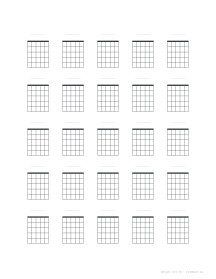
A page of empty chord diagrams
Chord boxes are the quickest way to show a fretting-hand shape. Each diagram on this sheet has six vertical strings, five fret spaces and a thick nut along the top, with a short line above for the chord name. Fill them with dots for fingers, numbers for which finger to use, and O or X marks above the nut for open and muted strings.
Guitar teachers use a page to hand out the chords for a new song, or to build a student’s personal chord dictionary one shape at a time. Players record barre-chord shapes, jazz voicings and partial chords they find while practising. Songwriters write every chord in a new song on one sheet, so the whole band can learn the changes without guessing at voicings.
Guitar or ukulele
The default page draws 25 six-string boxes on Letter in a five-by-five layout, sized so a dot and a finger number fit comfortably between frets. The ukulele variation switches to four strings with a slightly wider string spacing, fitting 30 boxes on Letter. It suits standard GCEA ukulele tuning, baritone ukulele and mandolin shapes alike.
On A4 the extra page height adds a sixth row, giving 30 guitar boxes or 36 ukulele boxes.
Making song sheets
For a song sheet, add the header variation and write the title at the top, then list the chords in the order they first appear. Pair it with guitar tab paper for riffs and picking patterns, or with staff paper if you also want the melody in notation.
Teachers handing out chord libraries can set Pages in the PDF in Advanced options to print a booklet at once. Because chord boxes are a fixed layout, they print the same on any printer; choose Actual size so every box is the same size from page to page, and use a pencil for shapes you are still working out.
A useful habit is to note fingering inside each dot, with 1 for the index finger through 4 for the little finger, and T if you wrap the thumb over the neck. For barre chords, draw a curved line across the strings covered by the index finger. Those small details make a chord library useful months later when you have forgotten how you played a shape.
More sheet music & tab sheets
Frequently asked questions
How many chord boxes are on a page?
Twenty-five guitar chord boxes on Letter, in five rows of five, and thirty on A4 in six rows of five. The ukulele version fits thirty on Letter and thirty-six on A4.
How do I fill in a chord diagram?
The vertical lines are strings, low E on the left, and the horizontal lines are frets with the nut as the heavy bar at the top. Draw a dot where each finger presses, an O above an open string and an X above a muted one. Write the chord name on the line above the box.
How do I show a chord higher up the neck?
Write the starting fret number beside the top fret line, for example 5fr. The nut bar then simply marks the top of the diagram, and the dots are read relative to that fret.
Can I use these chord boxes for ukulele?
Choose the ukulele variation, which draws four strings instead of six. For standard GCEA tuning, the leftmost line is the G string. The four-string boxes also work for mandolin chord shapes.
What are blank chord charts used for?
Teachers write out the chords for a song or lesson, players record shapes they discover or alternate voicings, and songwriters keep a reference of every chord in a new song so bandmates can learn it quickly.
Last updated · About us