What makes good manuscript paper
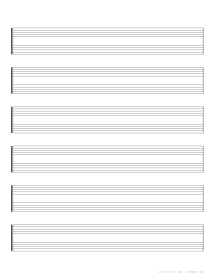
Music paper, also called staff paper or manuscript paper, is ruled with groups of horizontal lines for writing music. It looks simple, but three measurements decide whether it is pleasant to use:
- The line gap: the distance between two neighbouring lines in a staff, sometimes called a staff space. A five-line staff is four gaps tall.
- The space between staves: the white space separating one staff from the next, where ledger lines, lyrics, dynamics and chord symbols go.
- The layout: single staves, grand staves for piano, tablature, or chord boxes.
Handwritten music needs more room than engraved music. A pencil notehead is bigger than a printed one, and you need space for erasing and correcting.
Staff sizes and rastral gauges
Music engravers describe staff height with rastral numbers, a system dating from when staves were ruled with a rastrum, a pen with five nibs. There is no single official table, and published lists differ by a percent or two, but these are the sizes most often quoted in engraving references:
| Rastral | Staff height | Line gap | Typical use |
|---|---|---|---|
| 0 | 9.2 mm | 2.3 mm | Large-print and educational music |
| 1 | 7.9 mm | about 2.0 mm | Large-print parts |
| 2 | 7.4 mm | about 1.85 mm | Piano music, songbooks |
| 3 | 7.0 mm | 1.75 mm | Single-line parts, a common default |
| 4 | 6.5 mm | about 1.6 mm | Sheet music and choral music |
| 5 | 6.0 mm | 1.5 mm | Choral and smaller formats |
| 6 | 5.5 mm | about 1.4 mm | Full scores, pocket editions |
| 7 | 4.8 mm | 1.2 mm | Ossia and cue staves |
| 8 | 3.7 mm | about 0.9 mm | Miniature scores |
These numbers are for printed music, which is read, not written on. For handwriting, choose something at or above rastral 0. Our default line gap is 2.2 mm, an 8.8 mm staff, which suits pencil work for most adults. Students and beginners often prefer 3 mm or more; experienced copyists who write small may go down toward 1.75 mm. The generator’s line gap runs from 1.5 mm (a 6 mm staff, about rastral 5) up to 5 mm.
- Staff2.2 mm gap, 8.8 mm staff
- Grand staffbraced pairs for piano
- Guitar tabsix lines, 1.35 × wider
- Guitar chord boxesfive frets, name line above
Spacing between staves
The gap between staves is just as important as the staff itself. Notes far above or below the staff need ledger lines, and you need space for dynamics, slurs, lyrics or chord symbols.
- Tight spacing (around 8–10 mm) fits more staves per page, good for sketches and exercises that stay within the staff.
- Default spacing (13 mm in the generator) leaves room for a couple of ledger lines and markings.
- Wide spacing (18 mm or more) is best for vocal music with lyrics under every note, or for teaching.
As a rule of thumb, increasing the line gap and the space between staves together keeps the page looking balanced. Here is how many fit on one sheet with the default 13 mm between staves:
| Paper | Staves, 1.75 mm gap | Staves, 2.2 mm | Staves, 3 mm | Grand staves, 2.2 mm | Guitar tab, 2.2 mm |
|---|---|---|---|---|---|
| US Letter | 13 | 12 | 10 | 6 | 9 |
| A4 | 14 | 13 | 11 | 7 | 10 |
Single staff vs grand staff
A single staff is five lines and is used for melody lines, single instruments, voices and ear-training exercises. Choose staff paper for most writing.
A grand staff pairs two staves joined by a brace, normally treble clef on top for the right hand and bass clef below for the left. It is the standard for piano, organ, harp and other keyboard instruments. Middle C sits on a ledger line exactly between the two staves. In the generator the two staves of each pair sit four staff spaces apart, joined by a bar at each end, so at the default settings each grand staff reads as one unit with clear space before the next. Use grand staff paper for piano composition, lead sheets with a bass line, and keyboard theory exercises.
Tablature
Tab shows where to put your fingers rather than which pitch to play. Each line represents a string and you write the fret number on it. The generator offers:
- Guitar tab: six lines, low E at the bottom.
- Bass tab: four lines.
- Banjo tab: five lines.
Tab lines are spaced a little wider than staff lines (1.35 times the staff gap in the generator), because you write numbers rather than noteheads and two-digit frets need room. A “TAB” label at the start of each staff is optional. Our guitar tab paper is set up with six lines and the label on.
Tab does not show rhythm clearly. Many guitarists pair a staff above with tab below, or add rhythm stems above the tab numbers. If you need both, print standard staff paper and tab paper and keep them together, or write rhythm marks in the space between tab staves.
Chord boxes
Chord boxes (also called chord diagrams or fretboard grids) are small grids that show a chord shape. Vertical lines are strings, horizontal lines are frets, and a heavy bar at the top marks the nut. Dots show where to place fingers; an X or O above a string marks muted or open strings.
The generator’s chord boxes have five frets each, with a guide line above every box for the chord name. Choose six strings for guitar or four for ukulele. A page of chord chart paper works for building a personal chord dictionary, writing out song charts for a band, or teaching beginners. For chords played higher up the neck, write the starting fret number beside the top fret line.
Setting up music paper in the generator
- Choose Music paper and select the layout: staff, grand staff, tab or chord boxes.
- Set the line gap. Bigger for beginners and young students, smaller for experienced writers.
- Adjust space between staves for lyrics or ledger lines.
- Add a title or header fields such as Name and Date for lessons and assignments.
- Set Pages in the PDF for a full manuscript book and switch on page numbers.
Printing tips
- Choose landscape for tab or orchestral sketches when you want longer lines per system.
- For a composition notebook, print a booklet: A5 on A4 or Half Letter on Letter, double-sided and folded.
- A darker line colour photocopies better if you plan to hand out copies.
- Print at 100% so line gaps match what you set, which matters if your students use a stencil or if the sheet must match printed music in size.