Variations
What prints with the starting settings
| Paper | US Letter — 215.9 × 279.4 mm (8.5 × 11 in) |
|---|---|
| Layout | Grand staff (piano) |
| Systems on this page | 6 |
| Line gap | 2.2 mm (staff 8.8 mm tall) |
| Margins | 1/2″ |
| Line weight | 0.2 mm (bold 0.35 mm) |
| Print setting | Scale 100% / Actual size |
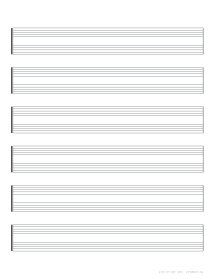
Two staves, one instrument
Piano music needs two staves read together, because the right and left hands play in different registers at the same time. Grand staff paper prints them as linked systems: a treble staff above, a bass staff below, a solid brace joining them on the left and bar lines running through both at each end. Writing on systems rather than loose staves keeps the hands aligned beat for beat, which matters as soon as chords or counter-melodies appear.
Piano teachers use it for theory assignments, scale and chord exercises, and simplified arrangements for students. Students practise copying passages, which builds note-reading fluency across both clefs. Composers and arrangers sketch accompaniments, and organists and harpists use the same format, adding a pedal line on a separate staff when required.
Spacing between the hands
On this paper, the gap between the treble and bass staves equals four line spaces, about 8.8 mm at the default size. That inner space is where middle C and nearby ledger notes live, as well as dynamics that apply to both hands. Between systems there is 13 mm, enough for ledger lines, fingering numbers and pedal markings.
For beginners, choose the bigger-staves variation. A 2.8 mm line gap makes notes on lines and spaces easier to tell apart, and the slightly larger space between systems helps young students keep track of which system they are on.
Making a lesson book
Turn on the student header so every assignment carries a name and date, then set Pages in the PDF under Advanced options to print a term’s worth at once. Page numbers make it easy to refer to “page 4, second system” in a lesson. Landscape orientation suits short exercises that are wider than they are tall, such as a two-octave scale in both hands.
Print at Actual size so the line gap stays true, and use heavier paper if the pages will live on a piano music rack.
When arranging a song for piano, a helpful first pass is to write the melody in the treble staff and only the root of each chord in the bass staff. Once the shape is right, fill in inner voices and rhythm. Working in pencil on paper lets you try several left-hand patterns, such as block chords or broken arpeggios, on adjacent systems before deciding.
More sheet music & tab sheets
Frequently asked questions
What is a grand staff?
Two five-line staves joined on the left by a brace and a shared bar line. The upper staff normally carries the treble clef for the right hand, and the lower staff the bass clef for the left hand. Piano, organ and harp music is written this way.
How many grand staff systems fit on a page?
With the default 2.2 mm line gap, a Letter page fits 6 systems and an A4 page fits 7. Bigger staves for lessons reduce the count, and the generator recalculates it automatically.
Where does middle C go on a grand staff?
On a ledger line midway between the two staves. On this paper the treble and bass staves are separated by four line spaces, which leaves room for middle C and a ledger note or two either side without collisions.
Are the clefs printed?
No, the staves are blank. Draw a treble and bass clef for standard piano music, or two treble clefs for higher-register duets and some harp or organ parts.
Can I use grand staff paper for choir music?
A simple SATB setting can be written as a grand staff with soprano and alto in the treble, tenor and bass in the bass clef. Open choral scores with separate staves for each part are better written on blank staff paper.
Last updated · About us