Variations
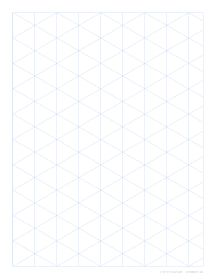
What prints with the starting settings
| Paper | US Letter — 215.9 × 279.4 mm (8.5 × 11 in) |
|---|---|
| Triangle side | 25.4 mm = 1″ |
| Margins | 1/2″ |
| Line weight | 0.18 mm (bold 0.35 mm) |
| Print setting | Scale 100% / Actual size |
Big and bold
Fine isometric grids are for detail. A one-inch grid is for scale and clarity: drawings you can see across a room, shapes big enough for young children to colour, and plans where each triangle is one real-world unit. It is also the size where isometric paper overlaps with patchwork, because one-inch triangles and 60° diamonds are common quilt pieces.
Ideas
- Classroom 3D: build with inch cubes and draw the model at the same size.
- Quilts: plan a design with 1 inch triangle templates or diamonds.
- Tabletop gaming: walls and buildings drawn to a one-inch scale alongside 1 inch hex paper.
- Signs and lettering: big block letters in 3D for posters.
Other sizes
For more detail, choose 1/2 inch or 1/4 inch isometric paper.
Printing
Print at 100% / Actual size and measure one triangle side: it should be exactly one inch.
More isometric sheets
Frequently asked questions
How big are the triangles?
Each side is exactly 1 inch (25.4 mm), and each row of triangles is about 0.87 inch (22 mm) tall.
How many triangles fit on a page?
About seven or eight triangle sides across a Letter page, so the grid is best for a few large shapes rather than detailed drawings.
What is it used for?
Large-scale 3D sketches and teaching, quilt layouts with 1 inch triangles and diamonds, mosaic tile plans, and tabletop terrain where one side equals one inch on the table.
Can I use it for cubes made of classroom blocks?
Inch cubes match it exactly: each cube edge is one triangle side, so a drawing is the same size as the model.
Last updated · About us