Variations
What prints with the starting settings
| Paper | A4 — 210 × 297 mm (8.27 × 11.69 in) |
|---|---|
| Triangle side | 10 mm = 0.394″ |
| Margins | 10 mm |
| Line weight | 0.18 mm (bold 0.35 mm) |
| Print setting | Scale 100% / Actual size |
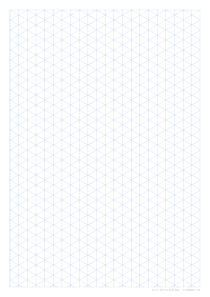
Cubes you can count
Isometric paper shows three faces of a box at once: top, left and right, all at the same scale. At 1 cm, each cube edge on the paper is the length of a standard classroom cube, so pupils can build a model, draw it, and count cubes in the drawing to find the volume. The large grid also makes mistakes easy to see and erase.
How to draw a cube
- Pick a point where lines meet and draw one vertical edge down one triangle side.
- From its top, follow the two upward diagonals one side each.
- Close the top face with two more diagonals to make a rhombus.
- Drop vertical lines from the outer corners and join the bottoms with diagonals.
Shade the top, left and right faces in three tones to make the cube look solid.
Beyond the classroom
The large triangles suit architectural massing sketches, game level layouts, quilt designs built from triangles and diamonds, and lettering in 3D block style. For finer detail, use 5 mm isometric paper; for an inch-based grid, use 1/2 inch isometric paper.
Printing
Print at 100% / Actual size. A row of ten triangle sides along a diagonal should measure 100 mm.
More isometric sheets
Frequently asked questions
What size are the triangles?
Every side is 10 mm. Triangle rows are 8.66 mm tall, because the height of an equilateral triangle is about 0.866 times its side.
Why is 1 cm isometric paper used in schools?
Many maths curricula ask pupils to draw solids made from 1 cm cubes. On this grid, each edge of a cube is one triangle side, so drawings match the cubes on the desk.
What are the vertical lines for?
The vertical edges of a cube or building. With them, a cube is drawn by following three printed lines; without them, the two sloping sets form a lattice of 60° diamonds.
Is there a dot version?
Yes, choose the dots-only variation, or see isometric dot paper for the full range of sizes.
Last updated · About us