Variations
What prints with the starting settings
| Paper | US Letter — 215.9 × 279.4 mm (8.5 × 11 in) |
|---|---|
| Triangle side | 12.7 mm = 1/2″ |
| Margins | 1/2″ |
| Line weight | 0.18 mm (bold 0.35 mm) |
| Print setting | Scale 100% / Actual size |
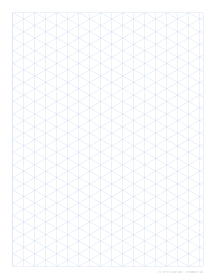
Room to draw boldly
Fine isometric grids are great for detailed technical sketches, but they can feel busy. At half an inch, the grid is open enough to draw with markers, to shade faces in colour and to sketch quickly at a whiteboard-like scale. It is a comfortable grid for younger pupils and anyone who wants a few big shapes rather than lots of detail.
Planning with 60° shapes
The same triangle grid underlies several patchwork shapes:
- Triangles: each cell is an equilateral triangle with half-inch sides.
- Diamonds: two triangles sharing a side make a 60° diamond, the basis of tumbling-block quilts.
- Hexagons: six triangles around a point make a hexagon with half-inch sides.
Colour in a design (turn off the vertical lines if it is made only of diamonds), then cut matching paper templates such as 60° diamonds at the size you need.
Sketching objects
Use it for furniture ideas, box and packaging mock-ups, LEGO-style builds and game maps. Each half-inch side can stand for one inch, one foot or one unit of whatever you are designing.
Printing
Print at 100% / Actual size on Letter or A4. Measure one side to confirm it is exactly 1/2 inch before using it for scaled plans.
More isometric sheets
Frequently asked questions
How big are the triangles?
Each side is 1/2 inch (12.7 mm), and each row of triangles is about 0.433 inch (11 mm) tall.
Can I plan a quilt on it?
Yes. With all three sets of lines the grid is a tiling of 60° triangles: pairs of triangles form 60° diamonds and six form a hexagon, so 1/2 inch triangles, diamonds and hexagons can all be planned on the same sheet. Turn off the vertical lines and only the diamond lattice remains.
Is it good for woodworking sketches?
For quick ones. If each triangle side equals one inch of timber, an 8 inch shelf is 8 sides long, which keeps proportions honest without a full technical drawing.
How is it different from 1/4 inch isometric paper?
The triangles are twice as big, so the page holds fewer of them. Use 1/4 inch isometric paper for detailed drawings.
Last updated · About us