Variations
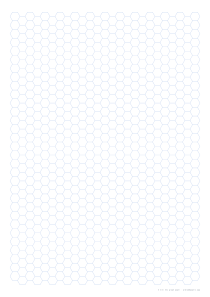
What prints with the starting settings
| Paper | A4 — 210 × 297 mm (8.27 × 11.69 in) |
|---|---|
| Hexagon side | 5 mm = 0.197″ |
| Across flats | 8.66 mm |
| Across corners | 10 mm |
| Margins | 10 mm |
| Line weight | 0.18 mm (bold 0.35 mm) |
| Print setting | Scale 100% / Actual size |
Where a fine honeycomb helps
Six-sided cells tile a page with no gaps and give every cell the same relationship to its neighbours, which makes hex paper useful well beyond gaming. At a 5 mm side length the grid is fine enough to feel like a texture, yet each cell is still big enough to color with a fine-liner.
- Quilters and paper piecers plan hexagon rosettes and colour runs before cutting fabric, counting pieces cell by cell.
- Game designers sketch strategy maps and abstract board games where dozens of cells must fit on one sheet.
- Students and teachers explore tessellations, symmetry, and counting patterns on a lattice that is not square.
- Science students sketch honeycomb and lattice structures, such as the hexagonal layout of carbon atoms in a graphene sheet.
- Journalers and doodlers use the cells for mood trackers and geometric fill patterns.
Flat or pointy, and which paper
Flat-top hexes stack in straight vertical columns, while pointy-top hexes line up in straight horizontal rows, which suits trackers read row by row. Board games and quilt diagrams use both. The variations above switch between them in one click.
A4 is the default here because 5 mm is a metric size, but Letter works equally well. If you want the honeycomb in a planner, choose A5 and print it single-sided, then trim to fit.
Printing tips
Hexagon edges are drawn as thin 0.18 mm lines, so the page looks light and uncluttered. When you plan to fill many cells with color, try the soft grey variant: the outlines remain visible but do not compete with your shading. Print at Actual size so the cells are true; a column of ten hexagons should measure 86.6 mm. For a whole workbook of pages, set Pages in the PDF in Advanced options and add page numbers.
For quilt planning, decide the finished size of a fabric hexagon first, say one inch per side, and treat each printed 5 mm cell as one piece. A rosette of seven hexagons, one centre ringed by six, is easy to sketch and color in different fabric combinations, and you can count every piece of each print directly from the sheet before you cut a single template.
More hexagonal sheets
Frequently asked questions
What size are the hexagons on 5 mm hex paper?
Each side is 5 mm long. That makes each hexagon 8.66 mm across the flats and 10 mm from corner to corner, so a column of ten flat-top hexagons stacked edge to edge spans 86.6 mm.
How is hex paper used for quilting?
Quilters color in cells to plan hexagon layouts such as rosettes and flower-garden patterns before cutting fabric. Each printed hexagon stands for one fabric piece at a reduced scale, so you can count how many pieces of each color you need.
Is 5 mm hex paper good for game prototypes?
For compact strategy maps, yes. Small cells let you fit a whole continent or a large board on one sheet, then mark terrain by coloring cells. For a map that miniatures will stand on, use the larger 1 inch hex paper.
What is the difference between flat-top and pointy-top?
Flat-top hexagons have a straight edge at the top and bottom and stack in neat vertical columns. Pointy-top hexagons have a corner at the top and bottom and line up in neat horizontal rows. The shapes are identical, only rotated by 30°.
Can I print it on Letter instead of A4?
Yes. Select Letter above and the hexagons keep their exact 5 mm sides; the page simply holds a slightly different number of rows and columns.
Last updated · About us