Variations
What prints with the starting settings
| Paper | US Letter — 215.9 × 279.4 mm (8.5 × 11 in) |
|---|---|
| Hexagon side | 6.35 mm = 1/4″ |
| Across flats | 0.433″ |
| Across corners | 1/2″ |
| Margins | 1/2″ |
| Line weight | 0.18 mm (bold 0.35 mm) |
| Print setting | Scale 100% / Actual size |
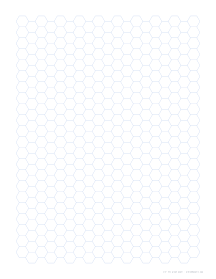
A drawing aid for ring structures
Organic chemistry is full of hexagons. Benzene, cyclohexane, pyridine and countless natural products are built on six-membered rings, and skeletal formulas draw carbon chains as zigzags whose bends sit at roughly 120°, the same angle as the corners of a regular hexagon. Quarter-inch hex paper gives you those shapes ready-made. Trace a cell for a ring, follow shared edges for fused ring systems, and walk along the zigzag of adjacent edges for a chain.
Undergraduates use it for problem sets and exam practice, where neat structures make mechanisms easier to follow and grade. Tutors sketch reaction steps for students, and high school chemistry teachers use it to introduce aromatic rings. Because each hexagon is only about 11 mm across the flats, you can fit a multi-step synthesis across a single Letter page and still have room for arrows and reagents.
Choosing grid weight and orientation
For chemistry, the grid should guide you without appearing in the final drawing. The pale-line variation prints the hexagons in a very light grey that disappears under a dark pen; photocopies and scans of your work will show mostly the structures. If you write long chains across the page, try pointy-top hexagons, whose edges give the left-to-right zigzag; the default flat-top grid runs zigzags up and down.
Outside the lab, the same 1/4 inch size works for small hex maps in solo or travel games, puzzle design, and quick mosaic planning. For larger cells to count and color, step up to 5 mm hex paper (5 mm sides) or for miniatures the 1 inch hex grid.
Printing a problem-set pad
Turn on the name, date and class header to make the sheet into a hand-in page. Under Advanced options, set Pages in the PDF to 10 or 20 and switch on page numbers to keep multi-page answers in order. Print at Actual size: a single hexagon should measure exactly 1/2 inch from one corner to the opposite corner, a quick way to confirm nothing was scaled.
A tip from tutors: draw the ring or ring system first, then add substituents, charges and lone pairs once the skeleton is in place. Writing heteroatoms such as N or O directly on a hexagon corner keeps the formula readable, and drawing arrows in a different color makes electron-pushing mechanisms easy to follow when you review your notes before an exam.
More hexagonal sheets
Frequently asked questions
Why do chemistry students use hexagon paper?
Six-membered rings such as benzene and cyclohexane are drawn as hexagons, and carbon chains in skeletal formulas zigzag at about 120°. Tracing along the hex grid keeps rings regular and bond angles consistent, so structures look tidy without a template.
How big is each hexagon?
Each side is 1/4 inch (6.35 mm). Across the flats the hexagon measures about 0.433 inch (11 mm), and corner to corner it is 1/2 inch (12.7 mm).
Can I draw fused rings like naphthalene?
Yes. Neighbouring hexagons share an edge, which is exactly how fused rings share a bond. Draw over two adjacent cells for naphthalene, or three in a row or bent for anthracene and phenanthrene.
Is 1/4 inch hex paper useful for anything besides chemistry?
It suits small hex maps for solo and pocket-sized games, hex-based puzzles, and tiling or mosaic sketches where a fine but countable cell size helps.
Which orientation should I use for long carbon chains?
Pointy-top hexes have edges at 30° either side of horizontal, so following them gives the familiar zigzag running left to right. Flat-top hexes, the default here, put the zigzag up and down the page, which suits a chain hanging below a ring.
Last updated · About us