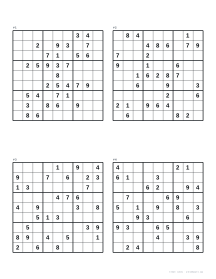
The rules
A sudoku is a 9 × 9 grid divided into nine 3 × 3 boxes. Some squares already contain digits, the clues. Fill every empty square with a digit from 1 to 9 so that:
- each row contains every digit once,
- each column contains every digit once,
- each 3 × 3 box contains every digit once.
That is all. There is no arithmetic; the digits could just as well be letters or colours. A well-made puzzle has exactly one solution, so every square can be worked out by reasoning.
Technique 1: scanning for hidden singles
Pick a digit and a box that doesn’t contain it yet. Every copy of that digit in a row or column crossing the box rules out that whole line inside the box. If only one empty square is left, the digit must go there. This is a hidden single, and it is the most useful technique of all.
Go through the digits 1 to 9 in turn, box by box, and easy puzzles fall quickly. You can scan rows and columns the same way: if a digit fits in only one square of a row, it goes there.
Technique 2: naked singles
Now turn it round. Look at one empty square and list the digits already in its row, column and box. If eight different digits are there, the ninth is the answer. This is a naked single, and it is handy where nearly full rows and columns cross.
Technique 3: pencil marks
When scanning stops finding answers, write small candidates in each empty square: every digit that could still go there. A tidy layout helps: put 1 in the top-left corner of the square, 5 in the middle and 9 in the bottom right, so you can see at a glance which digits are missing. Update the marks every time you place a digit. A square with one mark left is a naked single; a digit with one mark left in a row, column or box is a hidden single.
Technique 4: naked pairs
If two squares in the same row, column or box each have only the same two candidates, those two digits must go in those two squares, in some order. So you can cross them out of every other square in that row, column or box.
The same works for three squares: if three squares in a unit hold only three digits between them, a naked triple, those digits can be removed from the rest of the unit.
Technique 5: pointing and claiming
These two use the overlap between a box and a line.
- Pointing: if, inside a box, a candidate appears only in one row (or column), the digit for that box must be in that row. Cross it out of the rest of that row outside the box.
- Claiming works the other way: if, inside a row (or column), a candidate appears only within one box, the digit for that row must be in that box. Cross it out of the rest of the box.
Technique 6: hidden pairs
If two digits can each go in only the same two squares of a unit, those squares must hold those two digits. Any other candidates in the two squares can be erased. Hidden pairs are harder to spot than naked ones, because the squares still look busy.
Technique 7: the X-wing
Pick a digit. If it has exactly two possible squares in one row and exactly two in another row, and they line up in the same two columns, the digit must sit at opposite corners of that rectangle, whichever way round. Either way, both columns are taken, so cross the digit out of every other square in those two columns. The same works with columns and rows swapped.
Which techniques each difficulty needs
We ran 200 puzzles at each difficulty from our generator, the same puzzles you get from puzzle books 1 to 25, through a solver that always uses the easiest technique that works, and recorded the hardest one each puzzle needed.
| Difficulty | Clues | Scanning alone | Needs pencil marks | Beyond X-wing |
|---|---|---|---|---|
| Easy | 37 to 38 | 100% | 0% | 0% |
| Medium | 31 to 32 | 98% | 2% | 0% |
| Hard | 26 to 28 | 59% | 41% | 0% |
The generator uses these grades as well as the clue count. Easy puzzles must fall to singles. Medium ones may need a naked pair, pointing or claiming. Hard ones must need more than hidden singles, but never more than an X-wing, so no puzzle we print needs guessing. In practice most hard puzzles need naked singles or a pair, which means you will rarely need the last techniques here.
Printing puzzles
The sudoku generator makes puzzles in your browser at three difficulties, each with a unique solution, with answer pages at the back of the PDF. Change the puzzle book number for a new set. Choose four or six puzzles per page for a booklet, or one large puzzle per page for large-print sudoku, which suits older eyes and children learning.
Tips
The same techniques work on a samurai sudoku, where five grids overlap: start in the shared corner boxes, since a digit placed there counts for two grids at once.
- Work in pencil and keep an eraser handy.
- When stuck, switch method: scan by digit, then check single squares, then add pencil marks.
- Check each new digit against its row, column and box before writing it.
- If you hit a contradiction, the mistake is usually the last digit you placed or a pencil mark you forgot to update; that is why logic beats guessing.