Variations
What prints with the starting settings
| Paper | US Letter — 215.9 × 279.4 mm (8.5 × 11 in) |
|---|---|
| Numbers | 1 to 100 |
| Charts per page | 1 |
| Margins | 1/2″ |
| Line weight | 0.18 mm (bold 0.35 mm) |
| Print setting | Scale 100% / Actual size |
Thinking with the grid
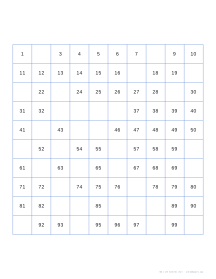
A missing-numbers chart is a small puzzle. When a square is empty, children can count on from the number before it, count back from the number after it, or look up and down the column: the number above is ten less and the number below is ten more. Using the column is the big step, because it shows they understand place value rather than just counting by ones.
Making it harder or easier
- Easier: cover some of the gaps with counters before handing the sheet out, so fewer have to be filled.
- Harder: ask children to fill each gap using only the column, and say how they know.
- Timed challenge: see how many gaps can be filled in two minutes, then finish the rest slowly.
- Beyond 100: use the 1 to 120 variation when the class is counting into the hundreds.
A sheet for every child
Because the gaps come from the puzzle number, you can print a different sheet for each table group with no repeats. Note the puzzle number on your copy so you can print the same one again for a later check.
Printing
Print at 100% / Actual size on Letter or A4. Two puzzles per page halves the paper while keeping squares large enough to write two-digit numbers.
More hundreds chart sheets
Frequently asked questions
How many numbers are missing?
About 40% of the squares are left empty, chosen at random. The number 1 is always shown so children have a starting point.
How do I get a different worksheet?
Change the puzzle number in the generator. Each number gives its own pattern of gaps, so a class can work on different sheets, and the same number always reproduces the same sheet.
Where is the answer key?
The complete hundreds chart is the answer key for every missing-numbers puzzle.
What age is this for?
Usually kindergarten to second grade (ages 5 to 8), once children can count to 100 and are learning that moving down a row adds ten.
Last updated · About us