Learning the times tables: the best order and a practice plan
There are 144 squares on a 12 × 12 times table grid, but only 78 different facts to learn, and the order you learn the tables in changes how many are new at each step. Here is the order schools use, the numbers behind it and a plan for practising at home.
A 12 × 12 multiplication chart has 144 squares, which sounds like a lot to memorise. But multiplication works in either order: 3 × 7 is the same as 7 × 3. Counted that way there are only 78 different facts, and 12 of them are the 1 times table, which needs no memorising at all.
The order in which the tables are learned matters because of those partners. Each new table brings fewer new facts than the one before it, because some of its facts were already learned as part of an earlier table.
The order schools use
England’s national curriculum sets out the order year by year, and it is a good guide wherever you live:
Year (age)
Tables to recall
Why this order
Year 2 (6 to 7)
2, 5 and 10
They follow counting in twos, fives and tens, and their answers end in predictable digits
Year 3 (7 to 8)
3, 4 and 8
The 4s are double the 2s and the 8s are double the 4s
Year 4 (8 to 9)
All tables up to 12 × 12
The 6, 7, 9, 11 and 12 tables complete the grid
In England every Year 4 pupil then takes the multiplication tables check, an on-screen test of 25 questions with six seconds to answer each. In the United States, the Common Core standards expect children to know all products of two one-digit numbers from memory by the end of grade 3.
How many new facts each table brings
The chart counts, for each table in that order, the facts that have not already been met in an earlier table. The numbers come straight from the grid, and they are encouraging.
New facts added by each times table
Learned in the England national curriculum order; 3 × 7 and 7 × 3 count as one fact (78 facts in all)
1 times table12
2 times table11
5 times table10
10 times table9
3 times table8
4 times table7
8 times table6
6 times table5
7 times table4
9 times table3
11 times table2
12 times table1
Show the numbers
New facts
Note
1 times table
12
16% of the grid known
2 times table
11
31% of the grid known
5 times table
10
44% of the grid known
10 times table
9
56% of the grid known
3 times table
8
66% of the grid known
4 times table
7
75% of the grid known
8 times table
6
83% of the grid known
6 times table
5
89% of the grid known
7 times table
4
94% of the grid known
9 times table
3
97% of the grid known
11 times table
2
99% of the grid known
12 times table
1
100% of the grid known
Stage 1: 1, 2, 5, 10 (42 facts)
Stage 2: 3, 4, 8 (21 more)
Stage 3: 6, 7, 9, 11, 12 (the last 15)
Each square is shaded by the stage at which it is first known. Because every fact has a partner, the last stage is far smaller than its five tables suggest.
Three things stand out:
After 1, 2, 5 and 10, more than half the grid is known (56% of the squares), before any of the “hard” tables.
The 3, 4 and 8 tables take it to 83%.
The last five tables add only 15 facts between them. The 7 times table, often called the hardest, adds just four: 7 × 7, 7 × 9, 7 × 11 and 7 × 12.
That is worth telling a child who is dreading the 7s.
A practice plan
Pick two or three tables at a time, starting with 2, 5 and 10. Type them into the times table worksheet as, for example, 2, 5, 10.
Start in table order, so the pattern is visible, then switch to random order once the child can say the table aloud.
Practise five to ten minutes a day. A 20- or 30-question sheet is about right. Write the time in the box at the top and try to beat it the next day, but treat accuracy as the goal before speed.
Add division once multiplication is secure, using the fact-family setting: knowing 6 × 8 = 48 should bring 48 ÷ 8 = 6 with it.
Use the missing-number setting (7 × __ = 56) to check a fact is really known rather than recited.
Mix in the old tables as new ones are added, so earlier facts are not forgotten.
Keep the multiplication chart on the wall while learning, then take it down for the timed sheets.
Tricks for the tricky ones
9s: for 9 × n up to 9 × 10, the tens digit is one less than n and the two digits add up to 9 (9 × 7 = 63).
11s: up to 11 × 9, write the digit twice (11 × 4 = 44).
12s: 12 × n is 10 × n plus 2 × n (12 × 7 = 70 + 14 = 84).
6s: double the 3s (6 × 7 = double 21 = 42).
Square facts such as 7 × 7 = 49 and 8 × 8 = 64 are worth learning as a set; five of the last 15 facts are squares (6 × 6, 7 × 7, 9 × 9, 11 × 11 and 12 × 12).
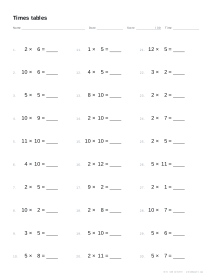
Example sheet: Times table worksheet – US Letter — open it in the generator from any paper page.
Sources
Facts in this guide were checked against these sources on 31 October 2026. Figures marked as our own data were calculated with the same code that runs our tools.
The 2, 5 and 10 times tables, which follow the patterns of counting in twos, fives and tens. England's national curriculum sets them for Year 2, then the 3, 4 and 8 tables in Year 3, and all tables up to 12 × 12 by the end of Year 4.
How many times table facts are there to learn?
The 12 × 12 grid has 144 squares, but because 3 × 7 and 7 × 3 are the same fact there are only 78 different facts, and 12 of those are the 1 times table.
Why is the 7 times table said to be the hardest?
It has no easy pattern, but by the time it is learned in the usual order, all but four of its facts are already known from other tables: only 7 × 7, 7 × 9, 7 × 11 and 7 × 12 are new.
How long should times table practice take?
Short and often works best: five to ten minutes a day on a small set of facts, rather than an hour once a week. A 20- or 30-question sheet takes about that long.
When do children in the US learn their times tables?
The Common Core standards expect children to know from memory all products of two one-digit numbers by the end of grade 3. Many schools then extend to 12 × 12.