Variations
What prints with the starting settings
| Paper | US Letter — 215.9 × 279.4 mm (8.5 × 11 in) |
|---|---|
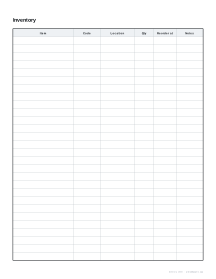
| Columns | Item, Code, Location, Qty, Reorder at, Notes |
| Rows on this page | 28 |
| Margins | 1/2″ |
| Line weight | 0.18 mm (bold 0.35 mm) |
| Print setting | Scale 100% / Actual size |
Know what you have
Running out of something important, or buying a third bottle of something you already had, are both inventory problems. A paper stock list solves them with almost no effort: write each item once, note where it lives and how many you need on hand, then update the quantity whenever you check.
Setting up a list
- Walk through the space shelf by shelf and write each item in the order you find it, so counting later follows the same route.
- Fill in the location column with the shelf, box or drawer.
- Decide a reorder level for each item: enough to last until the next shopping trip or delivery.
- Count and fill in the quantity.
Uses
- Kitchen and pantry: dried goods, tins and freezer contents, paired with the meal planner.
- Classrooms and offices: paper, pens, glue and printer supplies.
- Craft stashes: yarn, fabric, thread and beads by colour code.
- Small businesses and stalls: stock counts before and after a market day.
Printing
Print at 100% / Actual size. Keep the sheet on a clipboard near the shelves and write counts in pencil so they can be updated.
More logs & budgets sheets
Frequently asked questions
What are the columns?
Item, Code, Location, Qty, Reorder at and Notes. The code column suits SKUs, barcodes or your own short labels.
What does "Reorder at" mean?
The quantity at which you buy more. When a count drops to that number or below, the item goes on the shopping list.
How often should I count?
For a pantry or classroom, once a month is plenty. A small shop might count fast-moving items weekly and everything else quarterly.
Can I track craft supplies?
Yes. Use the code column for thread or bead colour numbers and the location for the box or drawer.
Last updated · About us