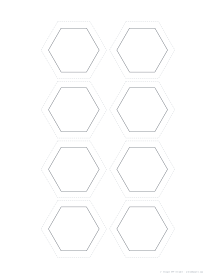
What makes EPP different
In most quilting, pieces are sewn together with a sewing machine along a measured seam allowance. In English paper piecing, each fabric piece is first wrapped around an exact paper template, and then neighbouring pieces are stitched together edge to edge by hand. The paper gives every shape a precise edge, which makes it possible to join hexagons, diamonds and other shapes that are awkward on a machine. It is completely portable: a small tin of papers, fabric, needle and thread is enough.
The method is old. Hexagon patchwork was popular in Britain by the late 1700s, and Colonial Williamsburg holds an American quilt top from 1800 to 1840 made of small hexagons folded around paper templates. The name Grandmother’s Flower Garden for hexagon rosettes came later, in the early twentieth century, and the pattern was at its most popular in the 1920s and 1930s.
Printing accurate templates
Accuracy starts with the template. If your printer shrinks the page by 3%, a 1-inch hexagon becomes 0.97 inches, and a rosette of seven shapes will no longer meet the next rosette cleanly.
- Print the EPP templates at 100% / Actual size, never “Fit to page”.
- Measure a side of one shape with a ruler. A 1-inch hexagon should measure exactly 1 inch along each side.
- If it is off, calibrate your printer once and reprint.
- Cut the paper shapes accurately along the line, using sharp paper scissors or a rotary cutter and ruler for straight edges.
| Hexagon side | Across the flats | Point to point | Papers per Letter page | With seam outline | Fabric pieces per fat quarter | To cover a 50 × 60 in throw |
|---|---|---|---|---|---|---|
| 1/2 in | 0.87 in | 1 in | 60 | 24 | 225 | 4,619 |
| 3/4 in | 1.3 in | 1.5 in | 28 | 15 | 124 | 2,053 |
| 1 in | 1.73 in | 2 in | 15 | 8 | 83 | 1,155 |
| 1 1/4 in | 2.17 in | 2.5 in | 8 | 6 | 54 | 740 |
| 1 1/2 in | 2.6 in | 3 in | 6 | 6 | 35 | 514 |
| 2 in | 3.46 in | 4 in | 2 | 2 | 24 | 289 |
Figures come from our template engine: papers per page are counted on a Letter sheet, plain and with the seam outline switched on, which spaces the shapes out so each outline can be cut round. Fabric pieces are cut edge to edge in a honeycomb from an 18 × 22 inch fat quarter, so expect a few fewer if you fussy cut. The last column is the number of hexagons in a 50 × 60 inch throw, before any border.
Cutting the fabric
Each fabric piece is the template plus a seam allowance on every side, normally 1/4 inch. Turn on the seam allowance outline in the generator to print a second, larger outline you can use as a cutting guide, or simply cut by eye leaving roughly 1/4 inch all round.
Basting
Basting holds the fabric around the paper.
- Glue basting: run a fabric glue pen along the paper edge, fold the seam allowance over and press. Quick and tidy.
- Thread basting: fold the allowance over and tack it in place with large stitches through the paper, or through the fabric folds only so the paper slips out easily later.
Fold neatly at each corner so the points stay sharp. Diamonds and jewels have narrow points where the fabric tails stick out; leave the tails and fold them out of the way.
Stitching pieces together
Place two basted shapes right sides together with the edges aligned. Use a fine needle and thin thread that blends with the fabric. Whip stitch along the edge with small, even stitches, catching just a couple of threads of each fold, and avoid stitching through the paper. A knot at each corner keeps the points from opening. Open the pieces and add the next one.
The classic first project is a Grandmother’s Flower Garden rosette: one centre hexagon surrounded by six others, often with a ring of twelve more around that.
Shapes and what they make
- Hexagons tile on their own and form rosettes and honeycombs.
- 60° diamonds make six-pointed stars and tumbling blocks.
- Jewels (elongated hexagons) make stars and long rows.
- Half-hexagons make straight edges for borders and rows.
- Tumblers and triangles make striped rows and modern designs.
Finishing
When the whole piece is joined, press it, remove the remaining papers, and either appliqué it onto a background fabric or quilt it as it is. Card-stock papers in good condition can go back into the tin for the next project.