Variations
What prints with the starting settings
| Paper | US Letter — 215.9 × 279.4 mm (8.5 × 11 in) |
|---|---|
| Side length | 1/2″ |
| Shape size | 1″ × 0.866″ |
| Margins | 1/2″ |
| Line weight | 0.18 mm (bold 0.35 mm) |
| Print setting | Scale 100% / Actual size |
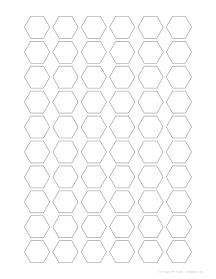
The flower garden size
Half-inch hexagons are small enough to make delicate rosettes and big enough to handle comfortably. Seven hexagons make one flower: a centre and a ring of six. A quilt of these takes a long time, which is part of its appeal: English paper piecing is slow, portable hand sewing you can take anywhere.
How to use the papers
- Print and cut the templates exactly on the line; accuracy here decides how well the hexagons fit together.
- Cut fabric about 1/4 inch larger all round, using the seam allowance variation as a guide if you like.
- Baste the fabric over each paper with thread or a fabric glue pen, folding crisply at each corner.
- Whip stitch hexagons together edge to edge with tiny stitches, then remove the papers once each hexagon is surrounded on all sides.
The English paper piecing guide covers each step in more detail.
Planning a design
Colour a sheet of 1/2 inch hexagon graph paper first; its hexagons are exactly this size, so you can count how many papers of each colour you need.
Printing
Print at 100% / Actual size and measure one side: it should be exactly 1/2 inch. Even a small scaling error adds up across a quilt.
More epp templates sheets
Frequently asked questions
How are EPP hexagons sized?
By side length. A 1/2 inch hexagon has six sides of 1/2 inch, measures 1 inch from corner to corner and 0.866 inch across the flats.
How many templates fit on a page?
Sixty on Letter and sixty-six on A4 without seam allowance. With the seam allowance outline, each template needs more room, so 24 fit on Letter.
Do I need the seam allowance line?
Only if you want a guide for cutting fabric. Print one page with seam allowance as a fabric-cutting template and the rest without as basting papers.
What paper should I print on?
Ordinary 80–100 gsm printer paper works for glue basting; card stock (160–200 gsm) holds its shape better for thread basting and can be reused several times.
Last updated · About us