Variations
What prints with the starting settings
| Paper | US Letter — 215.9 × 279.4 mm (8.5 × 11 in) |
|---|---|
| Line spacing | 8.73 mm = 0.344″ |
| Cue column | 2 1/2″ |
| Summary box | 2″ |
| Margins | 1/2″ |
| Line weight | 0.18 mm (bold 0.35 mm) |
| Print setting | Scale 100% / Actual size |
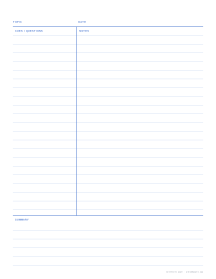
Cornell notes for bigger handwriting
The Cornell method is one of the most widely taught note-taking systems, but the standard template uses college ruling, which can feel cramped for younger students. This version keeps the same layout, a cue column, a notes area and a summary box, with wide ruled lines in the notes area.
The three sections
- Notes (right): main ideas and examples during the lesson, in short phrases.
- Cues (left): after the lesson, questions and key words that point to each part of the notes.
- Summary (bottom): two or three sentences that sum up the page in your own words.
Teaching the method
Start with the summary box, which is the most valuable and most often skipped. Model a page on the board, then have students write cue questions for each other’s notes and quiz a partner by covering the notes column.
Compare the college-ruled Cornell template and plain wide ruled paper.
Printing
Print at 100% / Actual size on Letter or A4. Punch for a ring binder so notes stay in lesson order.
More cornell notes sheets
Frequently asked questions
What is different from the standard Cornell template?
Only the ruling: lines are 11/32 inch (8.7 mm) apart, the US wide ruled standard, instead of college ruled. The cue column and summary box are the same.
Who is wide ruled best for?
Students in upper elementary and middle school, and adults with large handwriting.
How big are the sections?
The cue column is 2 1/2 inches wide on the left and the summary box at the bottom is 2 inches tall. The rest of the page is the notes area.
How do I use the Cornell method?
Take notes on the right during the lesson, write questions and key words in the cue column afterwards, and sum up the page in the summary box. The Cornell method guide explains each step.
Last updated · About us