Variations
What prints with the starting settings
| Paper | US Letter — 215.9 × 279.4 mm (8.5 × 11 in) |
|---|---|
| Vanishing points | 3 |
| Lines from each point | 36 |
| Margins | 1/2″ |
| Line weight | 0.18 mm (bold 0.35 mm) |
| Print setting | Scale 100% / Actual size |
When verticals converge
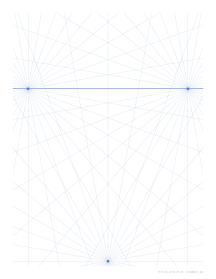
In one- and two-point perspective, vertical lines stay vertical, which is right for scenes at eye level. From a rooftop, a drone or a plane, though, the sides of buildings lean together as they go down. Three-point perspective adds a vanishing point for those verticals. This grid puts the horizon high on the page with its two vanishing points near the edges, and the third point at the bottom centre.
Drawing a building from above
- Start with the nearest vertical corner, drawn along a guide line towards the bottom vanishing point.
- From its top, follow guide lines to the left and right vanishing points to draw the roof.
- Drop the other visible corners towards the bottom point and close the walls with lines to the side points.
- Add floors with lines to the side points; they get closer together as they go down.
Looking up instead
Turn the sheet upside down and the same grid becomes a worm’s-eye view: the third point is now overhead and the horizon low on the page. That is the view for skyscrapers, towers and trees seen from the ground.
Getting a dramatic result
Strong three-point drawings keep the subject near the middle of the page, where distortion is mild. Shade the faces turned away from the light, and add small figures or cars for scale. For calmer scenes, use the one-point grid or the two-point grid on the perspective grid page; for drawings without convergence, try isometric paper. The perspective guide explains the theory.
Printing
Print at 100% / Actual size. Draw on tracing paper over the grid so the guides can be reused for many sketches.
More perspective grid sheets
Frequently asked questions
What is the third vanishing point for?
Vertical lines. When you look down from a height, the vertical edges of buildings are no longer parallel: they lean together towards a point below you. On this grid that point is at the foot of the page.
Can I draw a worm's-eye view, looking up?
Yes: turn the printed sheet upside down. The third point is then at the top, so verticals converge upwards, as when you look up at a skyscraper from the street.
Why does the drawing look distorted near the edges?
Three-point perspective exaggerates near the edges of the page, as a wide-angle lens does. Keep the main subject near the centre.
Is it hard to learn?
It builds on two-point perspective. Practise boxes on a two-point grid first, then add the third point for the verticals.
Last updated · About us