Variations
What prints with the starting settings
| Paper | US Letter — 215.9 × 279.4 mm (8.5 × 11 in) |
|---|---|
| Tables | 2, 5, 10 |
| Questions | 30 from 36 different facts |
| Answer page | Page 2 |
| Margins | 1/2″ |
| Line weight | 0.18 mm (bold 0.35 mm) |
| Print setting | Scale 100% / Actual size |
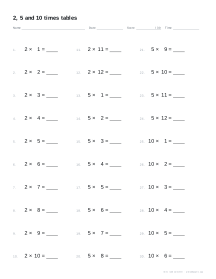
The first three tables
The 2s, 5s and 10s are where every child starts, and for good reason: they are counting patterns in disguise. Counting in tens gives the 10 times table, every 5s answer ends in 5 or 0, and every 2s answer is even. This sheet prints them in table order with large numbers, so the patterns are easy to spot.
Seeing the patterns
Colour the multiples of 2, 5 and 10 on a hundreds chart before starting: the 10s make a single column, the 5s make two, and the 2s make stripes. Counting along a number line in jumps of 2, 5 or 10 shows the same idea another way.
From order to random
When the child can say each table aloud, choose Random order, which mixes the three tables and swaps the order of the numbers. That is the moment the facts start to be known rather than counted. The guide to learning the times tables shows what comes next: the 3, 4 and 8 tables.
Printing tips
Print at 100% on Letter or A4. Thirty questions on a page leaves the numbers large for small hands; the Up to × 10 version has 20 even larger questions.
More times table worksheets sheets
Frequently asked questions
Why learn the 2, 5 and 10 times tables first?
They follow counting patterns children already know: in twos, fives and tens. England's national curriculum sets them for Year 2, ages 6 to 7, before any other tables.
What patterns help with these tables?
Answers in the 2 times table are all even; answers in the 5 times table end in 5 or 0; answers in the 10 times table end in 0. A hundreds chart shows each pattern clearly.
Should children learn up to × 10 or × 12?
Up to × 10 is enough for a first go; the × 11 and × 12 facts follow the same patterns and can be added later.
How much of the times tables do these three cover?
More than you might think. With the 1 times table, they cover 56% of the squares on a 12 × 12 multiplication grid, because every fact also counts in reverse.
Last updated · About us