Variations
What prints with the starting settings
| Paper | US Letter — 215.9 × 279.4 mm (8.5 × 11 in) |
|---|---|
| Grid | 12 × 12 (144 products) |
| Grids per page | 1 |
| Margins | 1/2″ |
| Line weight | 0.18 mm (bold 0.35 mm) |
| Print setting | Scale 100% / Actual size |
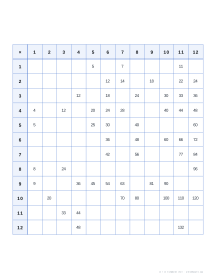
Practice with built-in hints
A blank multiplication chart asks for all 144 facts at once, which can be daunting. With about half the products already there, children fill gaps using what they see: the answer to the left plus the row number, the answer above plus the column number, or the matching fact across the diagonal. It’s a gentler way to build fluency, and each sheet takes only a few minutes.
Ideas
- Daily warm-up: a different puzzle number every day of the week.
- Pairs: two children swap sheets and check each other’s answers against the complete chart.
- Focus tables: circle the 7s and 8s rows before starting and do those first.
- Progress: time a sheet at the start of a unit and again at the end.
From practice to recall
When gaps are easy to fill, move on to the blank chart, where every product comes from memory. For younger learners, the 1–10 chart is a good reference. A similar puzzle for counting is the missing numbers hundreds chart.
Printing
Print at 100% / Actual size on Letter or A4.
More multiplication chart sheets
Frequently asked questions
How many products are missing?
About half of the 144 products, chosen at random. The factors along the top and side are always shown.
How do I get a different worksheet?
Change the puzzle number in the generator. The same number always makes the same sheet, so you can reprint it, and a new number gives new gaps.
Where is the answer key?
The complete multiplication chart has every product from 1 × 1 to 12 × 12.
Is it easier than a blank chart?
Yes. The products that remain act as hints: children can count on or back from a neighbouring answer in the same row.
Last updated · About us