Variations
What prints with the starting settings
| Paper | US Letter — 215.9 × 279.4 mm (8.5 × 11 in) |
|---|---|
| Shape | Square pyramid |
| Edge length | 1.97″ (reduced if needed to fit the page) |
| Margins | 0.236″ top, 0.236″ sides |
| Line weight | 0.18 mm (bold 0.35 mm) |
| Print setting | Scale 100% / Actual size |
From flat to solid
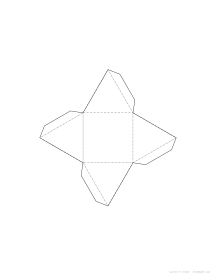
Folding a net is the best way to see how a 3D shape is put together. This pyramid net has a square in the centre and a triangle on each side; fold the triangles up until their tips meet, and the glue tabs hold the faces together. Because the triangles are equilateral, all eight edges are equal, which makes the model a nice illustration of a regular-faced solid.
Assembly
- Print at 100% and cut around the outside line, keeping the tabs attached.
- Score every fold line with a ruler and a blunt point.
- Fold all the edges in the same direction, with the printed lines inside or outside as you prefer.
- Glue one tab at a time, holding each joint for a few seconds.
In the classroom
- Count faces, edges and vertices, and check Euler’s formula.
- Measure the slant height and the vertical height and compare them.
- Compare the pyramid with a square box on the same base and of the same height (about 35 mm for 50 mm edges): the pyramid holds exactly a third as much, the one-third rule for pyramid volume.
- Draw the finished solid on isometric paper.
Printing
Print on card stock (160–220 gsm) for a sturdy model, at 100% / Actual size so the edges measure exactly what you set.
More box template sheets
Frequently asked questions
What shape does the net make?
A square pyramid whose four sloping faces are equilateral triangles, so every edge, around the base and up to the apex, is the same length.
How big is it?
Edges are 50 mm by default. You can set up to about 65 mm on Letter or A4; larger values are reduced to fit the page.
How many faces, edges and vertices does it have?
5 faces (1 square and 4 triangles), 8 edges and 5 vertices. Faces + vertices − edges = 2, as Euler's formula predicts.
How tall is the finished pyramid?
With equilateral faces, the height is the edge length ÷ √2, about 0.71 × the edge: about 35 mm for 50 mm edges.
Last updated · About us