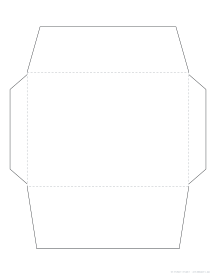
Envelopes: pick the size first
Envelope sizes are designed around card sizes:
| Envelope | Finished size | Holds |
|---|---|---|
| A2 | 4 3/8 × 5 3/4 in | Letter folded in four (4 1/4 × 5 1/2 in) |
| C6 | 114 × 162 mm | A6 cards, A4 folded twice |
| A7 | 5 1/4 × 7 1/4 in | 5 × 7 in invitations |
| DL | 110 × 220 mm | A4 folded in three |
| C5 | 162 × 229 mm | A5 cards, A4 folded once |
| #10 | 4 1/8 × 9 1/2 in | Letter folded in three |
A template is bigger than the envelope, because it includes the four flaps: the net is roughly twice the envelope’s height. So which paper you need depends on the envelope. We drew every template in our generator on every common paper to find out:
| Envelope | Finished size | Letter | A4 | Legal | Tabloid | A3 |
|---|---|---|---|---|---|---|
| A2 note card | 4 3/8 × 5 3/4 in | Full size | Full size | Full size | Full size | Full size |
| C6 | 114 × 162 mm | Full size | Full size | Full size | Full size | Full size |
| A7 invitation | 5 1/4 × 7 1/4 in | Full size | Full size | Full size | Full size | Full size |
| DL | 110 × 220 mm | Full size | Full size | Full size | Full size | Full size |
| C5 | 162 × 229 mm | 85% | 83% | 85% | Full size | Full size |
| #10 business | 4 1/8 × 9 1/2 in | Full size | Full size | Full size | Full size | Full size |
Computed by drawing each template in our generator on each paper, in whichever orientation fits better, with the default margins. A percentage means the template is scaled down to fit and the sheet says so.
If a template does not fit the paper you chose, the generator scales it down and prints a note saying by how much, so check for that note before cutting a batch. Envelope templates use 6 mm margins, the smallest most home printers handle, so that the nets fit Letter and A4 at full size.
Getting crisp folds
Score every fold line before folding: run a blunt point, such as an empty ballpoint or a bone folder, along a ruler on the dashed line. Fold towards the scored side and press the fold flat with the side of the tool. Scoring matters most on card and patterned paper.
Assembling an envelope
- Cut along the solid outline.
- Fold in the two side flaps.
- Fold the bottom flap up and glue it to the side flaps.
- Insert the card, then fold the top flap down and seal.
To use decorative paper, print the template once on plain paper, cut it out and trace round it.
Boxes and nets
The box templates make a cube, a square pyramid or a triangular prism with glue tabs. They are useful for maths lessons, favour boxes and small gifts. Print on card, cut out keeping the tabs, score all folds, then glue one tab at a time. Leave one face unglued on a cube to make a lid.
Lining and decorating
A lined envelope looks special and is simple to make. Cut a piece of patterned paper the shape of the top flap, a few millimetres smaller all round, slide it inside before gluing the bottom flap, and glue it to the inside of the top flap. Washi tape along the closed flap, a wax seal sticker or a stamped return address finishes it off.
For boxes, decorate the flat net before cutting and folding: stamps, drawings and stickers are much easier to apply to a flat sheet. Print the net on coloured card for a quick finished look, or on white card for children to colour in.
Printing
Print at 100% / Actual size, ideally on the paper weight recommended in the paper weight guide.