Variations
What prints with the starting settings
| Paper | US Letter — 215.9 × 279.4 mm (8.5 × 11 in) |
|---|---|
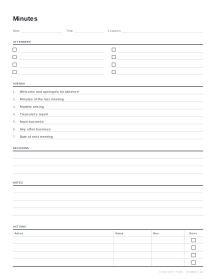
| Agenda | 7 typed items |
| Attendees | 8 names |
| Actions | 4 rows (fewer on small paper): action, owner, due, done |
| Decisions box | Yes |
| Margins | 1/2″ |
| Line weight | 0.18 mm (bold 0.35 mm) |
| Print setting | Scale 100% / Actual size |
Minutes, not a transcript
The secretary’s job is to record outcomes. This sheet guides that: the agenda is printed in order, a Decisions box sits below it, and the Actions table at the bottom collects each task with an owner and a date. The notes area in between is for the short context a decision needs, not a word-for-word account.
The standard agenda
The pre-filled agenda follows the order most clubs, school committees and parent associations use:
- Welcome and apologies for absence
- Minutes of the last meeting
- Matters arising
- Treasurer’s report
- Main business
- Any other business
- Date of next meeting
Type your own items to replace them, up to ten.
After the meeting
Write up the minutes within a day or two while they are fresh, check the actions with the chair, and circulate them with the next agenda. Keep the signed copies in date order: they are the group’s record of what it decided.
Printing tips
Print at 100% on Letter or A4, one sheet per meeting, plus a few blank copies for long meetings. For a quick one-to-one rather than a formal meeting, use the one-on-one template.
More meeting notes sheets
Frequently asked questions
What goes in meeting minutes?
The name of the group, the date, time and place, who was present and who sent apologies, each agenda item with the decisions made, any votes, the actions agreed and the date of the next meeting.
Should minutes record everything that was said?
No. Robert's Rules of Order, the parliamentary guide many clubs and committees use, advises that minutes record what was done rather than what was said. Note the decision and who will act on it, not the debate.
What is a standard agenda order?
This template uses a common order: welcome and apologies, approval of the last minutes, matters arising, reports, the main business, any other business and the date of the next meeting. Edit the list to suit your constitution.
How are the minutes approved?
Usually at the next meeting, under "minutes of the last meeting", after which the chair signs them. That is why the item sits near the top of the agenda.
Last updated · About us