Variations
What prints with the starting settings
| Paper | US Letter — 215.9 × 279.4 mm (8.5 × 11 in) |
|---|---|
| Axes | −6 to 6 on both axes |
| Planes per page | 4 |
| Margins | 1/2″ |
| Line weight | 0.18 mm (bold 0.35 mm) |
| Print setting | Scale 100% / Actual size |
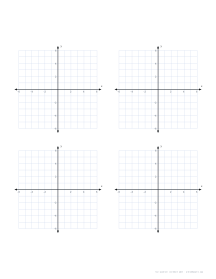
One page, four graphs
Four planes per page are ideal when a lesson has several short graphing tasks: plotting y = 2x + 1 and y = −x + 4 on separate grids, showing a shape before and after a reflection, or comparing the graphs of four related equations. Students see all their answers together, and teachers have one sheet to mark.
Lesson ideas
- Transformations: draw a shape in the first plane, then translate, reflect and rotate it in the others.
- Families of lines: graph y = x, y = 2x, y = 3x and y = −x to compare slopes.
- Quadrant practice: plot points with mixed signs and name each quadrant.
- Matching: give four graphs and ask students to write each equation.
Choosing a range
A range of −6 to 6 keeps the squares a comfortable size for four planes per page. For larger values, use the −10 to 10 variation or move to one plane per page. Students new to coordinates can start with the first-quadrant grid.
Printing
Print at 100% / Actual size on Letter or A4 so squares stay square.
More coordinate planes sheets
Frequently asked questions
What range do the axes cover?
−6 to 6 on both axes, numbered every two units. The variation extends the range to −10 to 10 with smaller squares.
Why four per page?
Homework often has several short graphing questions. Four planes on one sheet keeps each question on its own grid without using four pages.
What can I graph on such a small grid?
Straight lines with small intercepts, simple parabolas near the origin, plotted points and transformations of small shapes all fit well.
How do I label the planes?
Write the question number or equation in the space above each plane. Use the full-page coordinate plane for detailed graphs.
Last updated · About us