Variations
What prints with the starting settings
| Paper | US Letter — 215.9 × 279.4 mm (8.5 × 11 in) |
|---|---|
| Words placed | 12 of 12 |
| Grid | 15 × 11 squares |
| Margins | 1/2″ |
| Line weight | 0.18 mm (bold 0.35 mm) |
| Print setting | Scale 100% / Actual size |
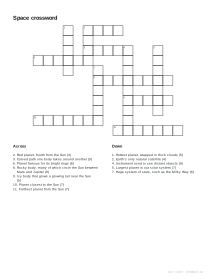
A ready-made space crossword
Twelve clues on the solar system: six planets, the Moon, comets, asteroids, orbits, galaxies and the telescope used to see them. Each clue describes a fact rather than a name, so solvers have to know that Jupiter is the largest planet or that Neptune is the farthest from the Sun.
In the classroom
Use it as a review at the end of a solar system unit, a homework sheet, or a quiet starter at the beginning of a lesson.
- Hand out the puzzle without the answer page, then project page 2 to mark it together.
- Switch on the word bank for younger classes or as support for some pupils.
- Ask early finishers to write two new clues of their own and swap with a partner.
Make your own science puzzles
The crossword maker turns any vocabulary list into a puzzle: the water cycle, parts of a plant or the bones of the body. Type the term and its definition on each line.
More crossword maker sheets
Frequently asked questions
What are the answers?
Mercury, Venus, Mars, Jupiter, Saturn, Neptune, Moon, Comet, Orbit, Galaxy, Asteroid and Telescope, shown in the grid on page 2.
Are the space clues accurate?
Yes. Mercury is the planet closest to the Sun, Venus the hottest, Jupiter the largest and Neptune the farthest, as NASA's planet facts describe them. Pluto has been classed as a dwarf planet since 2006, so it is not called a planet here.
Which grades is it for?
It matches what children usually meet in a solar system unit in grades 3 to 6. Switch on the word bank for the younger end.
Can I add the rest of the planets?
Yes. Add Earth and Uranus with your own clues, or a dwarf planet such as Pluto or Ceres, and the grid is rebuilt to include them.
Last updated · About us