Variations
What prints with the starting settings
| Paper | US Letter — 215.9 × 279.4 mm (8.5 × 11 in) |
|---|---|
| Grid | 21 × 21 squares |
| Clue area | None |
| Margins | 1/2″ |
| Line weight | 0.18 mm (bold 0.35 mm) |
| Print setting | Scale 100% / Actual size |
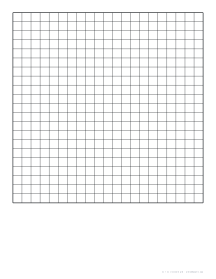
A canvas for constructors
A 21 × 21 grid has 441 squares and room for about 140 answers, so building one is a real project. Paper is still the easiest place to start: sketch the black-square pattern in pencil, fill in long theme entries, and then work the short words around them. When you are happy, ink it in and copy it out cleanly.
Building a grid
- Pick theme answers and place them symmetrically, often across the middle rows.
- Add black squares in a pattern that looks the same when the page is rotated half a turn.
- Keep words at least three letters long and make sure every white square is part of both an Across and a Down answer.
- Number the starts and write clues in the Across and Down columns.
Choosing a size
Large grids suit experienced solvers and themed puzzles. For quicker puzzles, use the 15 × 15 crossword grid or a mini crossword grid for classroom vocabulary practice.
Printing
Print at 100% / Actual size. Turning off clue lines gives the biggest squares, best for drafting; turn them on for a finished one-page puzzle.
More crossword grid sheets
Frequently asked questions
Why 21 × 21?
It is the standard size of large weekend crosswords, including many Sunday puzzles in US newspapers. Daily puzzles are usually 15 × 15.
How big are the squares?
Without clue lines, the grid fills the width of the page and each square is about 9 mm on Letter. With clue lines, the grid shrinks to make room and squares are about 7.5 mm.
Does the grid have black squares?
No. All squares are blank so you can design your own pattern. Shade the black squares with a marker; most constructors keep the pattern symmetrical under a half-turn.
Where do the clue numbers go?
Write a small number in the top-left corner of every square that starts an Across or Down answer, numbering left to right, top to bottom.
Last updated · About us