Variations
What prints with the starting settings
| Paper | US Letter — 215.9 × 279.4 mm (8.5 × 11 in) |
|---|---|
| Layout | Family job list |
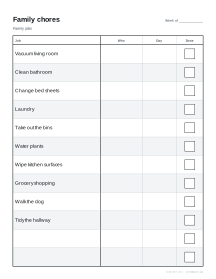
| Chores | 10 printed, 2 empty rows |
| Margins | 1/2″ |
| Line weight | 0.18 mm (bold 0.35 mm) |
| Print setting | Scale 100% / Actual size |
Who does what, at a glance
A shared list ends the “I thought you were doing it” conversation. Each job gets a row with three columns: who does it, which day, and a box to tick when it is done. Anyone walking past the fridge can see what is left.
Setting it up
- List the jobs the household does every week. Ten to twelve is typical.
- Share them out together on Sunday evening and write the names in the Who column.
- Pick a day for each job, so they do not all pile up at the weekend.
- Tick as you go, and look at the chart together at the end of the week.
Keeping it fair
- Rotate the jobs nobody likes each week, by writing names in a different order.
- Match jobs to ages: a young child can water plants or tidy shoes; a teenager can cook a meal. The chore chart hub has ideas by age.
- Add a family goal with the goal and reward box version, such as a film night when every box is ticked.
Printing tips
Print at 100% on Letter or A4. Keep one blank copy to photocopy, or laminate it and reuse it with a dry-wipe pen.
More chore chart sheets
Frequently asked questions
How is this different from the kids' chore chart?
The kids' chart has a tick box for every day, for routines done daily. The family chart lists each job once with who, which day and done, for weekly jobs shared out across the household.
How should we share out the jobs?
Fill in the Who column together at the start of the week. Rotating the less popular jobs each week, such as cleaning the bathroom, keeps it fair.
Can I add more jobs?
Yes. Type them on new lines, or write them into the empty rows at the bottom.
Does it work for flatmates?
Yes. It is a simple shared rota: list the jobs, write a name and a day beside each, and stick it on the fridge.
Last updated · About us