What fabric count means
Cross-stitch is worked on fabric with a regular grid of holes. Each X is made over one square of that grid, so the count, the number of squares per inch, decides how big each stitch is and how big the finished piece will be.
Aida is the most common cross-stitch fabric. Its threads are woven in bundles, creating clearly visible squares with holes at each corner, so beginners can see exactly where each stitch goes. Aida is sold by count: the number of stitches per inch.
| Aida count | Stitches per inch | Stitches per cm | Stitch size |
|---|---|---|---|
| 11 | 11 | 4.3 | 2.31 mm |
| 14 | 14 | 5.5 | 1.81 mm |
| 16 | 16 | 6.3 | 1.59 mm |
| 18 | 18 | 7.1 | 1.41 mm |
Higher counts mean smaller stitches, finer detail and a smaller finished piece from the same chart. 11-count is big and easy to see, popular with children and for bold designs. 14-count is the classic all-rounder. 16- and 18-count suit detailed designs and stitchers comfortable with small holes.
Evenweave and linen
Evenweave and linen have single, evenly spaced threads instead of bundles. They come in higher counts (25, 28 and 32 are common) but are usually stitched over two threads, so each cross covers a 2 × 2 thread square. The effective stitch count is half the thread count:
| Fabric | Stitched | Effective stitches per inch |
|---|---|---|
| 25-count | over two | 12.5 |
| 28-count | over two | 14 |
| 32-count | over two | 16 |
So a pattern on 28-count evenweave over two comes out the same size as on 14-count Aida. Fine work such as petit point is sometimes stitched over one thread, giving the full thread count. The generator offers grids for 11, 14, 16, 18, 22, 25, 28 and 32 count; for evenweave over two, choose the effective count (14 for 28-count, 16 for 32-count).
How to calculate finished size
The formula is simple:
Finished size = number of stitches ÷ stitches per inch
Work out width and height separately. For a design 140 stitches wide and 100 stitches tall:
| Fabric | Width | Height |
|---|---|---|
| 11-count | 140 ÷ 11 = 12.7 in | 100 ÷ 11 = 9.1 in |
| 14-count | 140 ÷ 14 = 10.0 in | 100 ÷ 14 = 7.1 in |
| 16-count | 140 ÷ 16 = 8.75 in | 100 ÷ 16 = 6.25 in |
| 18-count | 140 ÷ 18 = 7.8 in | 100 ÷ 18 = 5.6 in |
For centimetres, multiply the inch result by 2.54, or divide stitches by stitches per centimetre.
How much fabric to buy
Add a border of plain fabric around the design for framing and for holding the work in a hoop. Many stitchers allow around 2 to 3 inches (5–8 cm) on every side; for a large frame or a mount, allow more. For the 140 × 100 design on 14-count, that means a piece roughly 14–16 inches wide by 11–13 inches tall. Check your framer’s requirements if you are having it professionally mounted.
Working backwards
To fit a design into a frame, rearrange the formula: stitches = size × count. A 5 × 7 inch frame opening on 14-count fits 70 × 98 stitches; on 18-count, 90 × 126.
True-size grids vs design grids
The generator’s cross-stitch paper offers two kinds of grid:
True size (1:1)
Every cell is exactly the size of one stitch on the chosen fabric: 1.814 mm for 14-count. A Letter page with half-inch margins and edge numbering holds a 102 × 137 stitch grid, which would stitch up at 7.29 × 9.79 inches on 14-count. True-size grids are useful for:
- seeing the real finished size of a design before you start;
- laying the printout against fabric to check a count you don’t know;
- planning text and borders to fit a specific frame.
Print at 100% / Actual size, or the grid will no longer match the fabric.
Design grid (×2, ×3, ×4)
True-size cells are too small to draw symbols in. The enlarged design grid keeps the same stitch count logic but scales each cell up, so a 14-count grid at ×3 has 5.44 mm cells, comfortable for pencil, coloured pencil or symbols.
- 14-count, true size1.81 mm cells, exactly as stitched
- 14-count, ×3 design grid5.44 mm cells for drawing symbols
The generator’s spec table always tells you how big the grid on that page will stitch up, so you know a ×3 Letter page at 14-count covers 34 × 45 stitches, about 2.4 × 3.2 inches of finished embroidery.
| Paper | True size | ×2 | ×3 | ×4 |
|---|---|---|---|---|
| US Letter | 102 × 137 | 51 × 68 | 34 × 45 | 25 × 34 |
| A4 | 102 × 150 | 51 × 75 | 34 × 50 | 25 × 37 |
For a large design, print several design-grid pages and tape them together along the bold lines, or chart in sections and number each page. Here is how many Letter pages a chart takes at 14-count, turning the pages whichever way needs fewer:
| Design (stitches) | ×2 grid (51 × 68 per page) | ×3 grid (34 × 45 per page) | ×4 grid (25 × 34 per page) |
|---|---|---|---|
| 50 × 50 | 1 page | 4 pages | 4 pages |
| 80 × 100 | 4 pages | 6 pages | 12 pages |
| 140 × 100 | 6 pages | 12 pages | 18 pages |
| 200 × 150 | 9 pages | 24 pages | 36 pages |
Bold lines, numbering and centre marks
Three features make a chart easy to follow:
- Bold every 10. A heavier line every ten squares is the near-universal convention. Count in tens rather than ones, and mistakes become obvious. You can change it in the generator; some people prefer 5 for small designs.
- Numbering. Numbers along the edges at each bold line let you locate any square by row and column, which helps when you put the work down and pick it up again.
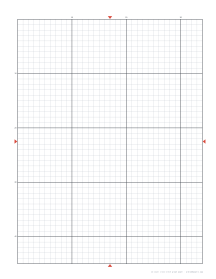
- Centre arrows. Most stitchers start from the centre of the design and the centre of the fabric so it ends up evenly placed. The arrows on our grid mark the middle row and column; fold your fabric in half both ways to find its centre.
Tips for charting your own designs
- Plan with the count in mind. Text needs at least 5–7 stitches of height to be legible; fine curves need higher counts or more stitches.
- Pencil first, ink later. Mark outlines and colour blocks lightly, then add symbols once the layout is settled.
- Keep a key. Write the thread colour for each symbol in the margin or on the back.
- Match the paper to the project. A design grid is for drawing; a true-size grid is for checking. Print one of each when planning a piece for a specific frame.
If you also knit, our knitter’s graph paper works the same way but uses rectangular cells matched to knitting gauge, since knit stitches are wider than they are tall.