Variations
What prints with the starting settings
| Paper | US Letter — 215.9 × 279.4 mm (8.5 × 11 in) |
|---|---|
| Peg pitch | 2.6 mm |
| Pegs per board | 841 (29 × 29 max) |
| Board size | 75.4 × 75.4 mm |
| Margins | 1/2″ |
| Line weight | 0.18 mm (bold 0.35 mm) |
| Print setting | Scale 100% / Actual size |
More detail in less space
Mini fuse beads are about half the size of the standard midi beads, so a 29 × 29 board shrinks from 145 mm to just 75.4 mm across. That lets you put a lot of detail into something you can wear or hang from a bag. Popular mini projects include earrings and pendants, keyring charms, fridge magnets, and detailed video-game sprites that would be too large or too blocky at midi size.
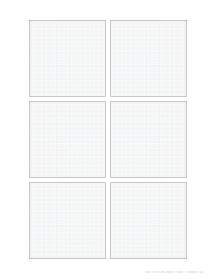
This template prints six true-size square boards on a single Letter or A4 sheet. That is ideal for planning a set of matching pieces, such as a pair of earrings plus a pendant, or for trying several color schemes for the same design side by side.
Designing at mini scale
At a 2.6 mm pitch, rings are small, so a fine-tip pen or sharp colored pencil works best. If you find the rings hard to fill, switch to the grid squares variation, which turns each peg into a solid cell. For a design you want to see larger while you draw it, use the single-board variation and then print a tiled sheet for the final pattern.
Mini bead charts work like cross-stitch charts: one bead per square. At about ten beads to the inch, a mini design comes out close to the size of the same chart stitched on 11-count fabric, so if you enjoy both crafts, the 11-count stitch grid is the nearest stitched equivalent.
Getting the pitch right
A 0.1 mm error per peg adds up to almost 3 mm across a full board, so printing at Actual size is essential. Measure across ten pegs on the printout; the distance should be 26 mm. If it is not, run the printer calibration once and download again.
Ironing minis needs a gentle touch. Use ironing paper and a lower heat than for midi beads, check often, and keep small beads and the iron away from young children.
For earrings, design both pieces on neighbouring boards on the same sheet, mirroring one if the design is asymmetric. Plan one bead at the top of each piece as the hanging point, and iron that area lightly so its hole stays open; an earring hook or jump ring then threads straight through it. Mark that bead on the template with a small circle so you remember not to fuse it shut.
More bead pegboard sheets
Frequently asked questions
What pitch does the mini template use?
2.6 mm from peg to peg. A 29 × 29 square board is therefore 75.4 × 75.4 mm, about half the width of a midi board with the same number of pegs.
How many boards are on each page?
Six square boards per Letter or A4 sheet, in three rows of two. Turn off tiling for a single board, or switch to the large rectangle, which fits one 49 × 69 board at mini size on the page.
Which beads fit this template?
Mini fuse beads of about 2.5–2.6 mm, such as Hama®-compatible mini beads. Midi beads are twice as large and need the square midi template.
Should I use tweezers for mini beads?
Most people do. A fine pair of tweezers or a bead pen makes placing mini beads much faster and keeps neighbouring beads from tipping over. Mini beads are a choking hazard and are generally recommended for older children and adults.
What are mini bead designs good for?
Their small size suits earrings, pendants, keyring charms, magnets and detailed characters. The same 29 × 29 board gives far more detail per centimetre than a midi board.
Last updated · About us