Variations
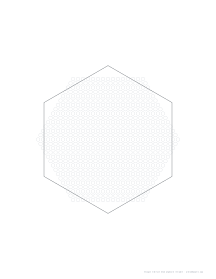
What prints with the starting settings
| Paper | US Letter — 215.9 × 279.4 mm (8.5 × 11 in) |
|---|---|
| Peg pitch | 5 mm |
| Pegs per board | 631 (29 × 29 max) |
| Board size | 145 × 145 mm |
| Margins | 1/2″ |
| Line weight | 0.18 mm (bold 0.35 mm) |
| Print setting | Scale 100% / Actual size |
Six-way designs
Square boards are best for pixel-style pictures; hexagon boards are best for anything round or radial. Because each peg has six neighbours, patterns can repeat around the centre six times, which is perfect for snowflakes, flowers and mandala coasters. Planning on paper first saves picking beads off the board.
Planning a design
- Colour the centre peg, then work outward ring by ring.
- Design one sixth of the pattern, a single wedge from the centre to an edge, and copy it around.
- Count beads per colour as you go.
- Place the printout under a clear board, or beside it, and follow it peg by peg.
Tips
Contrasting rings make strong coaster designs; a white or clear background around a coloured snowflake looks crisp. For a quick sketch without rings, use the dots variation, or 5 mm hex paper for free-form honeycomb sketches. Square and round layouts are on the square and circle pages.
Printing
Print at 100% / Actual size so the 5 mm pitch matches your beads.
More bead pegboard sheets
Frequently asked questions
How many pegs does the hexagon have?
631 pegs: 29 across the widest row, with 15 pegs along each of the six sides.
Is it the same size as a real hexagon board?
The pitch is the standard 5 mm for midi beads, so beads placed on the printout line up with the pegs on a board of the same layout. Large hexagon boards vary by brand, so count the pegs on yours before relying on the outline.
Why are the rows offset?
On a hexagon board, alternate rows are shifted by half a peg so the pegs form a honeycomb. That is what gives designs their six-way symmetry.
What can I make?
Coasters, snowflakes, stars, flowers, mandalas and hexagonal tiles that fit together into larger pieces.
Last updated · About us