Variations
What prints with the starting settings
| Paper | US Letter — 215.9 × 279.4 mm (8.5 × 11 in) |
|---|---|
| Panels | 12 |
| Gutter | 0.157″ |
| Margins | 1/2″ |
| Line weight | 0.18 mm (bold 0.35 mm) |
| Print setting | Scale 100% / Actual size |
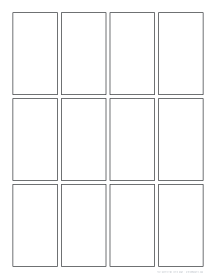
Four beats, one joke
Comic strips are tiny stories. The four-panel format gives a natural structure: introduce the situation, build it up, add a twist, and land the punchline in the last panel. Having three strips on a page encourages trying a few ideas quickly rather than polishing one.
Tips for strips
- Same framing: keep the characters at a similar size across panels so the changes stand out.
- Lettering first: write the words before drawing, so the balloons have room.
- Read left to right: put the speaker who talks first on the left of the panel.
- Simplify backgrounds: a horizon line and one object are often enough.
In the classroom
Use strips for story retelling, sequencing (cut the panels apart and reorder them), explaining processes like the water cycle, or practising new vocabulary in a foreign language. The equal panels make it easy for younger children to plan one idea per box.
For more varied pages, try the manga layout or other options on the comic book template page.
Printing
Print at 100% / Actual size on Letter or A4.
More comic book pages sheets
Frequently asked questions
How many panels are on the page?
Twelve: three strips of four equal panels each, separated by even gutters.
Why four panels?
The four-panel strip is a classic rhythm: set-up, development, twist and punchline. Japanese yonkoma and many newspaper strips use it.
Is it good for school?
Yes. A four-panel strip is a short, structured writing task: beginning, middle, problem and ending, with pictures. It works for retelling stories, explaining a science process or practising dialogue in a language.
Can I make a longer story?
Read the strips in order and treat the page as twelve panels, or print several pages.
Last updated · About us